Repair in Italy or Transport Home? The Cost Comparison
Two figures decide it: what a competent local repair costs, and what it costs to move the vehicle home. Both are knowable before anything is committed. The mistake is deciding first and finding out afterwards.
Distance, and what it means from Italy
Distances are long enough to change the answer. Munich to Cavallino-Treporti is roughly 550 km, to Tuscany around 900 km, to the far south considerably more. Add the Brenner and the arithmetic of transporting a 7.5-tonne vehicle home becomes a genuine four-figure question rather than a formality. Island sites — Elba above all — add a ferry to both the recovery and the repatriation, and that is worth establishing before any decision is taken.
Local repair capacity
Italian is the working language at site level and in most local workshops, and documentation obtained in Italian will need translating for a German insurer. EU member, euro, no customs complication. Italian body shops handle motorhomes competently in the camping corridors, where the local trade sees them constantly — this is one of the few countries where local repair is genuinely worth pricing rather than assuming.
The comparison in full
Against local repair: cost at local rates, parts availability and lead time, and the weeks you spend without the vehicle. Against transport home: haulage at the distances above, a workshop that knows the make, and the option of a controlled repair. Cutting across both: whether the vehicle is safe to be driven at all — covered in roadworthiness after damage — and whether repair cost has already passed replacement value, which turns the whole question into total loss arithmetic.
Recovery and repatriation themselves normally fall to a breakdown or assistance policy, not to comprehensive cover. Two separate files, two separate providers.
Where we inspect before the decision is made
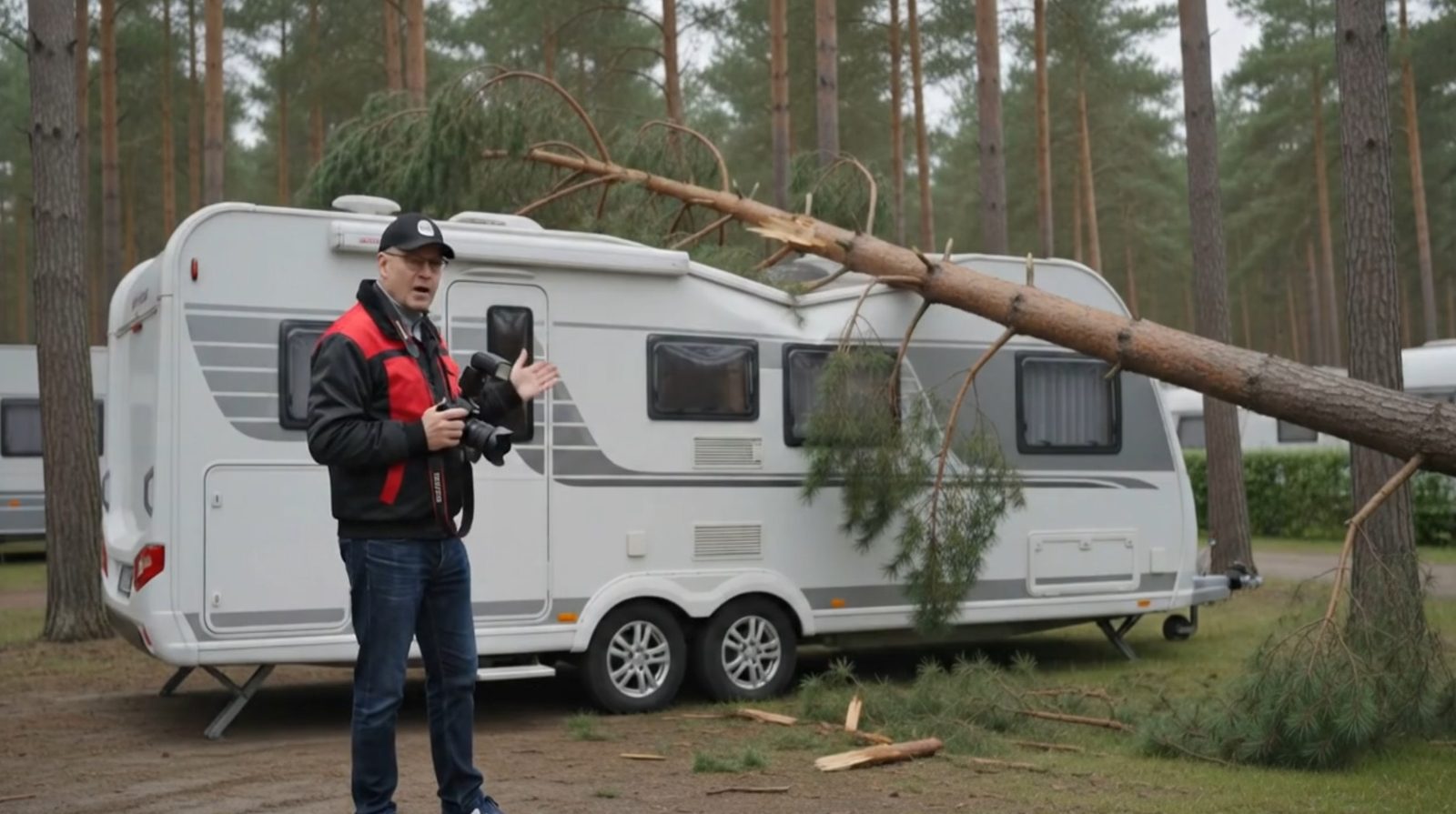
Italy carries more German camping traffic than any other country in this campaign, and it concentrates that traffic into a few very dense corridors: the eastern shore of Lake Garda, the Adriatic littoral around Cavallino-Treporti and Bibione, the Tuscan coast, and the Ligurian riviera. Cavallino alone holds one of the largest concentrations of pitches anywhere in Europe. Density matters for one specific reason — when a storm cell hits, it does not damage one vehicle, it damages dozens.
Where we inspect
Cavallino-Treporti · Lazise · Lido di Jesolo · Manerba del Garda · Marina di Bibbona · Albinia · Bardolino · Castiglione della Pescaia · Lacona · Peschiera del Garda
All localities and regions in Italy
How it works here
- Send photographs and your location by WhatsApp. First response within 2 hours.
- Triage: is the vehicle safe to move, and what must be secured before it is touched.
- On-site inspection, normally 48-72 hours from instruction.
- Report in the language of the insurer handling the claim, with translated annexes.
- If the amount is disputed: expert determination under section 84 VVG.
Comprehensive cover rests on your contract rather than on anyone's liability. The insurer bears the cost of the assessor it appoints; an independently commissioned appraisal is, as a rule, commissioned and paid for by the policyholder. We quote a fixed price before any work begins. Detail on that is on who pays for the appraisal.
Damage now? Send photographs before the vehicle is moved.
This page describes the standard pattern of the German motor insurance market and is general information, not advice on your individual contract. Cover always follows your own policy conditions. MOTOEXPERT is a network of certified automotive appraisers (Kfz-Sachverständige). We produce independent technical reports. We do not provide legal representation. Named places and makes are descriptive references only; no commercial connection with their proprietors is stated or implied.