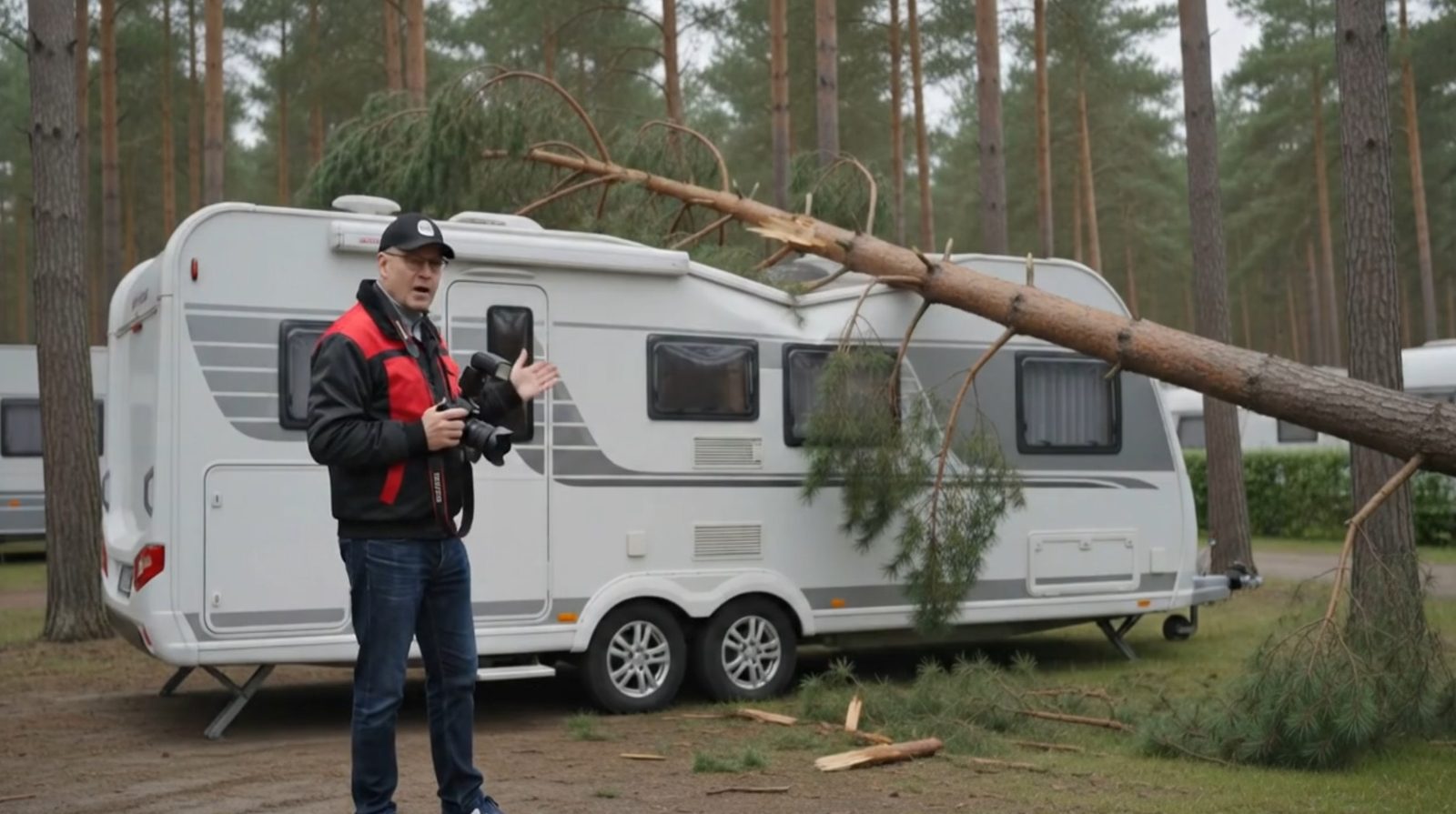
Storm, Gale and Fallen-Tree Damage at European Campsites
Storm cover in German policy conditions typically begins at wind force 8. A falling branch imposes a point load that deforms roof structure far beyond the visible puncture, and the tree gets cleared within hours — which is why the evidence has to be photographed before anyone arrives with a chainsaw.
The wind-force threshold
German motor policy conditions define storm as a weather-driven air movement from wind force 8 on the Beaufort scale — around 62 km/h and upwards. Below that threshold, damage attributed to wind is generally not a storm loss, though it may still be covered under another head such as impact or falling objects, and a vehicle set in motion by wind can raise different questions again.
This makes meteorological evidence unusually valuable in storm claims. A confirmed wind record for the location and time converts an argument into a fact, and it is easy to obtain in the days after the event and much harder later.
Falling trees and branches: why the visible hole understates it
Hail spreads its energy over a whole surface. A branch concentrates it at one point. The difference matters more than it sounds.
A branch striking a motorhome roof drives load through the outer skin into the sandwich core and then into the frame beneath. What you see is a puncture or a crushed area of perhaps a hand's width. What has often happened is that the roof structure has deflected across a much larger area, bonded joints between roof and side wall have been stressed, and the sealing line along that joint has been broken. None of that shows in a photograph of the hole.
The assessment therefore has to look well beyond the impact point: frame deflection, joint integrity along roof-to-wall and roof-to-cap seams, door and locker apertures out of square, and rooflights that no longer seat because the surface they sit in has moved.
Awnings and what was deployed at the time
An awning extended when the wind arrived is a total loss in most cases, and often takes its mounting rail and a section of the side wall with it. Two points to be clear about, because they decide the claim:
- An awning is generally covered as fitted equipment or accessory, frequently subject to a sum limit within the policy. It is not automatically covered to full replacement value, and the limit is worth knowing before you assume.
- Damage from an awning left extended in forecast high wind is where insurers most often raise the question of whether reasonable care was taken. There is no useful advice here other than the factual one: record the conditions, the forecast available to you at the time, and the sequence of events honestly.
The evidence problem specific to storm claims
Campsites clear storm damage fast. It is a safety obligation and they are right to do it. But the tree that struck your vehicle is likely to be sectioned and removed within hours, and with it goes the best evidence of what happened, how large it was, and whether it was sound.
Before the chainsaws arrive, photograph: the tree or branch in position against the vehicle; its diameter with a scale object; the break point and the condition of the wood at the break; the stump or parent limb; the surrounding trees; and the pitch as a whole. If the wood at the break is rotten, hollow or fungal, that is worth recording carefully — it does not change your comprehensive claim, but it can change who ultimately bears the loss.
Cover
| Event | Partial cover | Fully comprehensive |
|---|---|---|
| Storm from force 8, direct wind damage | Yes | Yes |
| Objects blown onto the vehicle by the storm | Yes | Yes |
| Tree or branch falling in a storm | Yes | Yes |
| Branch falling in calm conditions | Usually not a storm loss | Depends on cause and tariff |
| Awning and fitted accessories | Within the sum limit of the tariff | Within the sum limit of the tariff |
| Vehicle moved by wind and striking something | Generally not | Depends on the circumstances |
Scope follows your own policy conditions. The table describes the standard German market pattern.
Before you drive away
A vehicle struck on the roof by a branch may look drivable and be structurally compromised. Roof-to-wall joint integrity, the seating of rooflights, and whether the roof will shed water at motorway speed are the questions that decide whether the drive home makes the damage significantly worse. That assessment takes an inspection, not a glance.
Where we inspect for this type of damage
Italy: Cavallino-Treporti · Lazise · Lido di Jesolo
Slovenia: Bovec · Podčetrtek · Kobarid
Croatia: Rovinj · Baška · Krk · Novigrad · Orebić · Supetar · Umag · Vrsar
Austria: Döbriach · Faak am See · Salzburg · St. Wolfgang · Au an der Donau · Grundlsee · Hinterstoder · Kramsach · Längenfeld · Natters · Nenzing · Obertraun · Rauris · Rust · Schladming
Czech Republic: Černá v Pošumaví · Horní Planá
France: Fréjus · Marseillan-Plage · Argelès-sur-Mer · Biscarrosse
Netherlands: Oostkapelle · De Cocksdorp · Kamperland · Winterswijk
Poland: Chałupy · Łeba · Dziwnówek · Władysławowo
Switzerland: Sion · Tenero · Arolla · Brienz · Buochs · Engelberg · Flims · Interlaken · La Fouly · Lausanne · Lauterbrunnen · Lenzerheide · Locarno · Luzern · Morges · Sarnen · Vitznau
Frequently asked questions
What wind speed counts as a storm for insurance purposes?
German policy conditions normally set the threshold at wind force 8 on the Beaufort scale, roughly 62 km/h. Below that, damage is usually not treated as a storm loss.
A branch fell on my caravan on a calm day. Is that covered?
Not as storm damage, because there was no storm. Whether another head of cover responds depends on your tariff and on the cause of the fall, which is exactly why the condition of the wood at the break point is worth photographing.
Is my awning covered if the wind destroyed it?
Generally yes as fitted equipment, usually up to a sum limit set in the tariff rather than to unlimited replacement value.
The campsite cleared the tree before I photographed it. What now?
Ask the operator for their own photographs and their written record of the event, and obtain the meteorological record for the date and location. Extent and value can still be established; the cause is simply harder to evidence.
Can I drive home after roof impact damage?
Not without an assessment. A punctured or deflected roof can look benign and still fail to shed water at speed, and the joint between roof and side wall may have been stressed well beyond the visible damage.
More damage-type guides
- Hail Damage to Motorhomes and Caravans: Complete Assessment Guide
- Flood and Inundation Damage to Motorhomes and Caravans
- Theft and Break-In at a Campsite Abroad: Documenting the Claim
- Awning, Carrier and Accessory Damage: Where the Cover Limits Bite
- Glass, Rooflight and Impact Damage on Motorhomes and Caravans
- Is Your Motorhome Still Roadworthy? Post-Damage Safety Assessment
- Marten Bite, Rodent and Wildlife Damage
- Total Loss: Repair Cost, Replacement Value and Residual Value
- Water Ingress and Delamination: What Comprehensive Cover Does Not Pay
- Fire, Gas-System and Lightning Damage
- Manoeuvring and Pitch Damage: The Most Common Own-Fault Claim
- Vandalism Damage: Why It Sits Under Fully Comprehensive Only
Damage now? Send photographs before the vehicle is moved.
This page describes the standard pattern of the German motor insurance market and is general information, not advice on your individual contract. Cover always follows your own policy conditions. MOTOEXPERT is a network of certified automotive appraisers (Kfz-Sachverständige). We produce independent technical reports. We do not provide legal representation. Named places and makes are descriptive references only; no commercial connection with their proprietors is stated or implied. All trademarks belong to their respective owners.