Water Ingress and Delamination: What Comprehensive Cover Does Not Pay
Water entering through failed seals, ageing joints and general deterioration is wear and is not covered by comprehensive insurance. Water entering because an insured event broke something — hail cracked a rooflight, a branch punctured the roof — is. The whole claim turns on which of the two you are looking at.
The single most consequential distinction in this whole subject
Every motorhome and caravan leaks eventually. Sealant ages, bonded joints work loose under thermal cycling and vibration, and roof penetrations — rooflights, aerials, solar mountings, awning rails — are where it starts. That process is not an accident and no insurer covers it. It is wear, and it is excluded in every standard tariff.
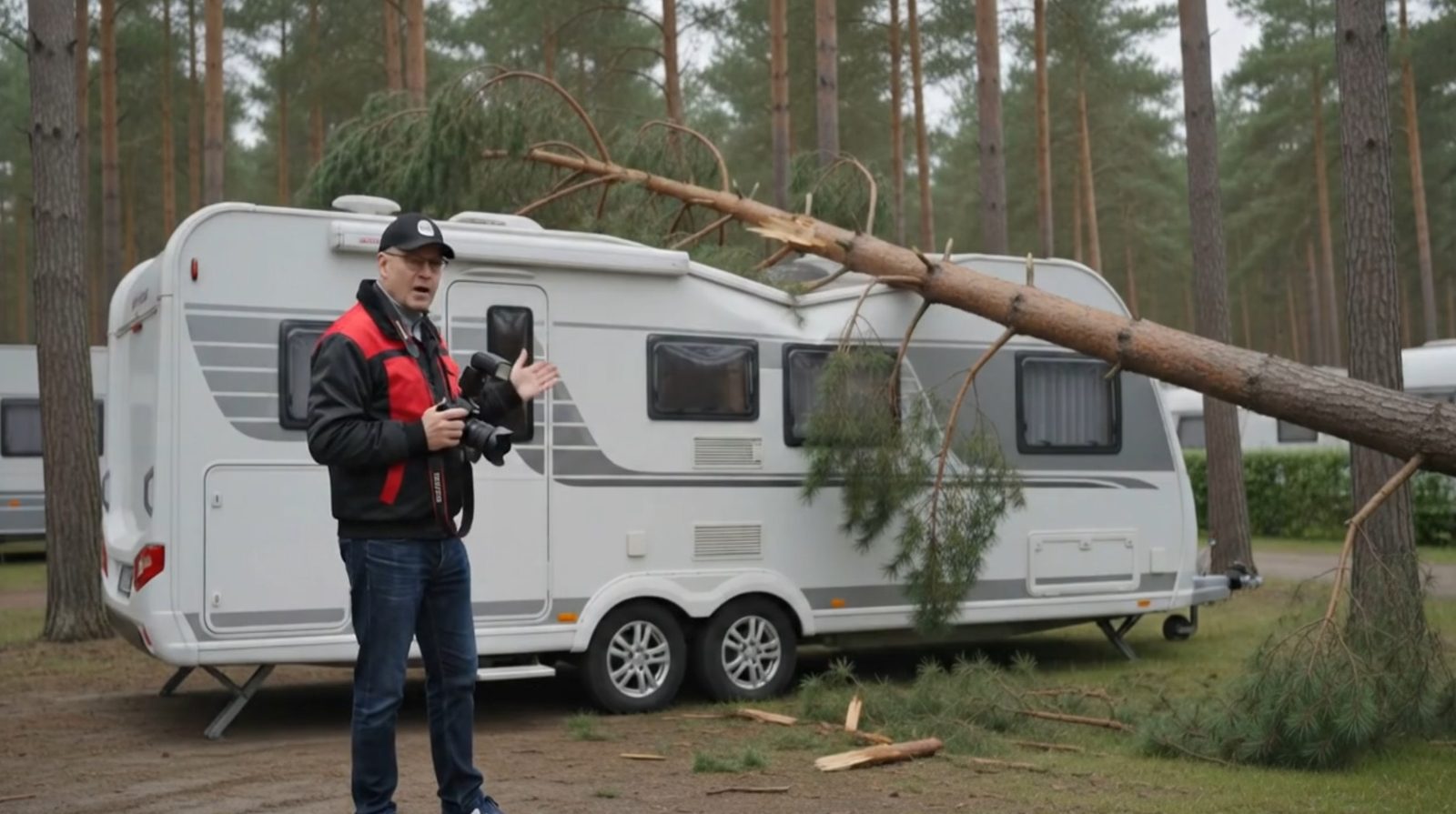
But water damage that follows an insured event is a different thing entirely. Hail cracks a rooflight and rain enters through the crack. A branch punctures the roof skin and breaks the roof-to-wall seal. A flood forces water into the floor build-up. In each case the water damage is a consequence of a covered cause and is covered with it.
Almost every dispute in this area is an argument about which of those two you have. Which is why the argument is won or lost on documentation, not on rhetoric.
What delamination actually is
Modern motorhome and caravan walls, roofs and floors are usually a sandwich: an outer skin of GRP or aluminium, a core of foam or timber-framed insulation, and an inner lining, all bonded together. The structure works because the bond works. Once water reaches the core, three things follow in sequence:
- The core absorbs and swells. Timber framing rots; some foams saturate rather than rot but lose their bond either way.
- The bond fails. The outer skin separates from the core. Visible as blistering, waviness or a soft area that gives under hand pressure.
- The structure loses stiffness. A sandwich panel is stiff because the two skins are bonded to the core. Unbonded, it is two thin sheets and a wet sponge.
This is the process that decides whether a wet motorhome is repairable or is an economic total loss. It cannot be assessed by looking at the outside, and it cannot be reversed by drying.
How it is established
Moisture measurement
Systematic readings across walls, floor and roof with a calibrated meter, recorded by zone rather than as a single verdict. German trade practice broadly reads below about 15 % as dry, 15–20 % as a warning zone requiring investigation, and above 20 % as wet with damage to be expected. Readings need to be taken methodically and mapped, because a single reading proves nothing.
Physical inspection of the joints
Every roof penetration, every bonded seam, the awning rail, the window frames and the service hatches. What is being looked for is the entry point and its condition — an aged, shrunken, cracked sealant line tells a very different story from a clean fracture through a rooflight dome.
Tapping and probing
Delaminated areas sound different and feel different. Mapping them establishes extent, which is what determines whether the repair is a panel section or a wall.
History
Damp-check records, service history, previous repairs and previous claims. A vehicle with documented annual damp checks and clean readings six months before the event is in a materially stronger position than one with no history at all.
Why an honest separation helps you
The instinct is to present all the damp as flood damage or all of it as hail consequence. It is the wrong instinct, for a practical reason: insurers examine exactly this point, and a report that ignores obvious pre-existing damp invites them to discount everything in it. A report that identifies the pre-existing condition, states its extent, and then separates the event-related damage from it, is the one that gets settled.
You lose the part of the claim that was never covered. You keep the part that was, and you keep it without a fight.
Where the boundary sits in practice
| Situation | Typical treatment |
|---|---|
| Damp found at annual service, no event | Wear — not covered |
| Delaminated wall on an older vehicle, seals aged | Wear — not covered |
| Water entering through a rooflight cracked by hail | Consequence of an insured event — covered |
| Roof-to-wall seal broken by a falling branch | Consequence of an insured event — covered |
| Floor saturated by flood water | Insured event — covered |
| Pre-existing damp made worse by a flood | Separated: the increment is covered, the pre-existing part is not |
Scope follows your own policy conditions. The table describes the standard German market pattern.
What to do
- Keep the damp-check records. They are the cheapest insurance against this argument that exists.
- After any roof event, have the seal lines around every penetration examined even if nothing is leaking yet. A broken seal that is documented at the time is covered; the same seal found leaking a year later is wear.
- Do not strip out linings or flooring before the inspection. What has been removed cannot be measured or mapped.
- Do not let anyone dry the vehicle out before readings are taken.
Where we inspect for this type of damage
Slovenia: Bovec · Kobarid · Mozirje · Podzemelj · Tolmin · Vinica
Switzerland: Bern · Vallemaggia
Austria: Au an der Donau · Klosterneuburg · Lofer
Netherlands: Hardenberg · Ommen
Czech Republic: Děčín
Poland: Pieniny
Frequently asked questions
Is water ingress covered by comprehensive insurance?
Not when it comes through failed seals or general deterioration — that is wear and it is excluded. It is covered when it follows an insured event, such as rain entering through a rooflight cracked by hail.
What moisture reading counts as wet?
German trade practice broadly treats readings below about 15 % as dry, 15–20 % as a warning zone, and above 20 % as wet with damage to be expected. Readings have to be mapped across the vehicle, not taken at one point.
Can a delaminated wall be repaired?
A localised area can be sectioned and rebuilt. Extensive delamination means replacing the panel, and on a floor that generally means a body-off operation whose cost approaches replacement value.
My caravan already had damp before the storm. Does that kill the claim?
No, provided the pre-existing condition is identified and separated honestly. What kills claims is a report that ignores it, because the insurer then has grounds to discount everything in it.
How long does it take for water to cause delamination?
Months to years depending on the core material, the volume of water and the temperature cycling. That timescale is itself evidence about when the ingress began.
More damage-type guides
- Hail Damage to Motorhomes and Caravans: Complete Assessment Guide
- Storm, Gale and Fallen-Tree Damage at European Campsites
- Flood and Inundation Damage to Motorhomes and Caravans
- Theft and Break-In at a Campsite Abroad: Documenting the Claim
- Awning, Carrier and Accessory Damage: Where the Cover Limits Bite
- Glass, Rooflight and Impact Damage on Motorhomes and Caravans
- Is Your Motorhome Still Roadworthy? Post-Damage Safety Assessment
- Marten Bite, Rodent and Wildlife Damage
- Total Loss: Repair Cost, Replacement Value and Residual Value
- Fire, Gas-System and Lightning Damage
- Manoeuvring and Pitch Damage: The Most Common Own-Fault Claim
- Vandalism Damage: Why It Sits Under Fully Comprehensive Only
Damage now? Send photographs before the vehicle is moved.
This page describes the standard pattern of the German motor insurance market and is general information, not advice on your individual contract. Cover always follows your own policy conditions. MOTOEXPERT is a network of certified automotive appraisers (Kfz-Sachverständige). We produce independent technical reports. We do not provide legal representation. Named places and makes are descriptive references only; no commercial connection with their proprietors is stated or implied. All trademarks belong to their respective owners.