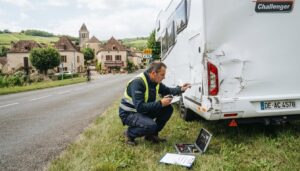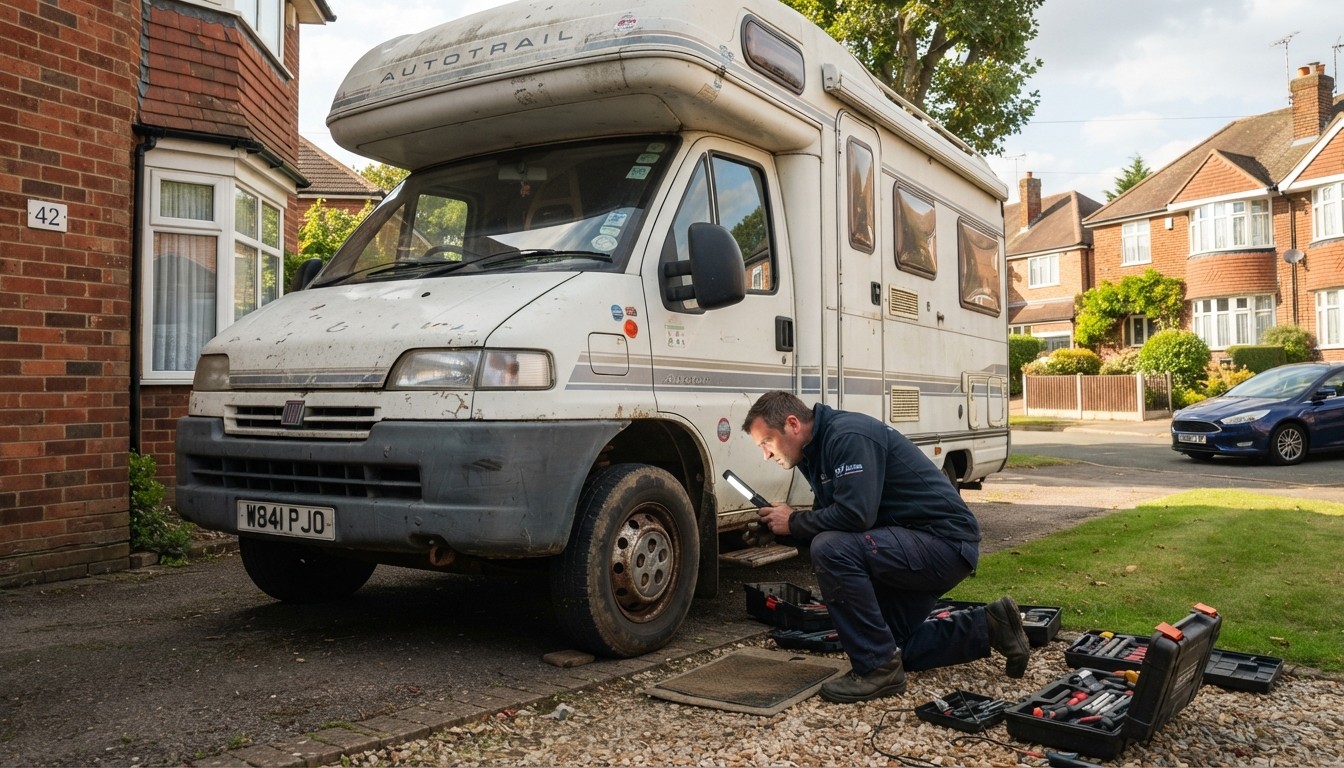
An independent motorhome pre-purchase inspection checks the vehicle and its living area before you commit, helping you make a decision based on evidence rather than appearance. A motorhome pre purchase inspection assesses the vehicle and its habitation area before you buy. A clean exterior and a reassuring seller cannot confirm the state of hidden structures, mechanical parts or living-area systems.
Moisture ingress means water entering a vehicle’s body through failed seals, joints or openings. An independent check can give you grounds to negotiate, proceed or walk away, but it cannot promise that the vehicle will stay fault-free. You can use the findings to ask better questions and judge the seller’s answers. The inspection records condition on one date; it does not guarantee future condition.
Key Takeaways
- Ask for checks of both the road vehicle and habitation area.
- Use the report to support your buying decision, not as a guarantee.
- Take damp readings in context, rather than relying on one number.
- Compare the VIN, mileage and paperwork before paying.
- Agree what the inspector can access and test before the appointment.
What Does a Motorhome Pre-Purchase Inspection Cover?
A useful purchase inspection checks both the road vehicle and the habitation area, since either can carry costly faults. Both areas matter: a sound engine does not confirm a sound living space, and vice versa.
The report can only assess parts and systems that the inspector can access and test. The agreed scope, available power and permission to drive all affect the checks.
A purchase inspection covers the base vehicle and habitation area, but findings apply only to items the inspector could access and test.
Base vehicle, chassis and road behaviour
The inspector can check the engine, transmission, brakes, suspension, tyres and steering. An underbody check can also show the state of exposed parts and areas that need closer review.
A road test may help assess how the vehicle behaves under way. It depends on access, permission and whether the vehicle is safe to drive. Without a road test, the report should say which road checks were not possible.
Habitation structure and fitted systems
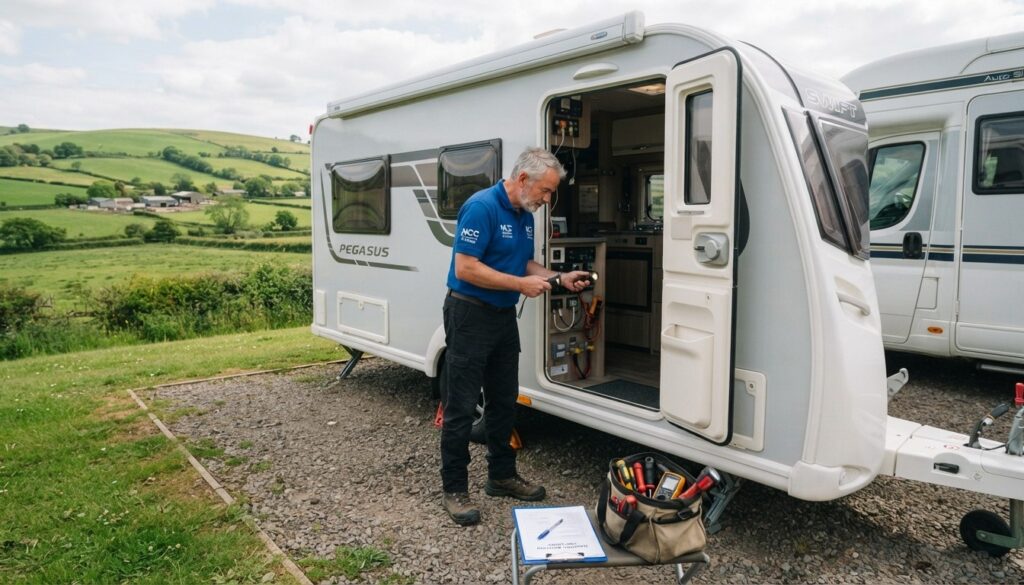
The habitation check can cover the body, roof, windows and floor, along with gas, water, heating, electrics, the leisure battery and appliances. Heating examples include Truma Combi, Webasto Air Top and Alde systems.
A visual gas-system check looks at visible parts and condition. It is not a G 607 gas tightness test, which checks for leaks through a separate procedure. In Germany, that test is generally due every two years.
| Area | Example checks | Assessment method | Limits |
|---|---|---|---|
| Base vehicle | Brakes, tyres, engine | Visual check and road test | Driving needs access and permission |
| Habitation structure | Roof, windows, floor | Visual and moisture checks | Hidden parts may remain out of reach |
| Habitation systems | Heating, water, electrics | Visual check and operation | Power and fuel affect testing |
Report scope and inspection limits
The report records observed condition, faults and items that need further checks. It should distinguish an operated system from one assessed by sight alone.
Access can be limited by stored belongings, locked areas or parts that need dismantling. A lack of mains power can also prevent operation of some appliances. A caravan may not have a road test, while a motorhome road test depends on safe access and permission.
Ask the inspector to state any limits clearly, so you can judge what the report does and does not establish. Confirm which systems can be powered and operated at the inspection appointment so the report can distinguish tested items from visual checks alone.
How Do You Spot Damp Before It Becomes Structural Damage?
A dry-looking exterior cannot rule out water trapped behind a wall panel or beneath the floor. Moisture ingress can stay concealed, so an inspection needs to look beyond visible marks.
Readings, surface condition and the location of possible leaks belong together. A clean finish alone cannot confirm that the structure is dry.
Check roof joints, openings and window frames
Water can enter around roof joints and openings, then spread inside the body. Check the seals around roof vents, aerials, solar-system penetrations, flues, hatches and windows.
Look for gaps, cracking or repairs to sealant that appear incomplete. A failed joint may let water travel from the entry point before it becomes visible indoors.
Look for interior warning signs
Move through the habitation area and note changes in the finish, smell or feel of surfaces. Pay close attention to the floor near windows, doors and wall edges.
- Staining on wall panels, ceilings or around windows
- Soft or swollen panels
- A musty odour or visible mould
- Cracked or damaged sealant
- Soft flooring or a floor that feels delaminated
These signs call for further checks, not an instant diagnosis. A stain may show where water travelled, rather than where it first entered.
Read moisture measurements in context
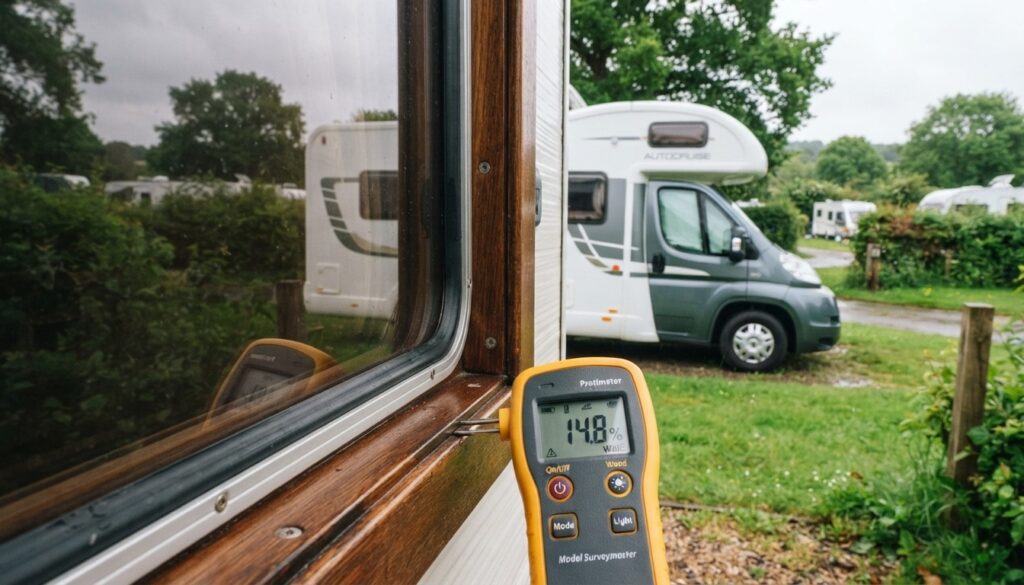
A moisture meter can help an inspector compare readings across relevant surfaces. The results need interpretation beside the material, location and visible condition.
A 0% display is not a universal pass mark: meters and materials differ. The reading does not prove that every hidden area is dry, especially where panels or flooring block access.
A suspicious result should be mapped and assessed, even if the surface looks clean. Ask whether the inspector can take readings at nearby points to show how the result changes across the area.
Note whether a reading sits near an opening, joint or floor edge, since that location may guide follow-up checks. Ask for any elevated reading to be recorded with its exact location and the inspector’s interpretation.
Crash Repairs: What the Body and Chassis Can Reveal
A fresh-looking panel can conceal repair work, so assess the whole vehicle rather than relying on one paint reading. Several clues may point to an area that needs closer checks.
A repaint or single paint-depth result does not prove a crash. The inspector compares features across the vehicle and looks for evidence that fits together.
Compare paintwork and body panels
Look for mismatched paint, uneven panel gaps, overspray, repaired seams and replaced panels. These may reflect earlier repairs, but they do not prove that an impact caused them.
Paint-depth readings can help compare one panel with another. Different readings are a clue, not a verdict, since repairs and factory finishes can vary.
Check whether the panels line up and whether the finish changes near joins. A single unusual area needs context from the rest of the body.
Inspect structural and underbody areas
The chassis rails and suspension mounting areas deserve close attention. The inspection can look for corrosion, unusual welds and repairs that differ from nearby sections.
It can also check for signs that the body-to-chassis connection has been disturbed. Look at the airbag warning lights when the ignition starts, since missing or unusual warning behaviour may need investigation.
Repairs may be sound, poor or hard to judge without further access. The report should describe what the inspector saw, rather than treating one mark as proof of serious damage.
Match the physical vehicle to its identity
Compare the VIN shown on the vehicle with the registration documents. Most modern VINs have 17 characters, though older vehicles can have exceptions.
Check that the VIN can be read and that the vehicle’s details match the paperwork. A mismatch may result from an error, but it needs a clear explanation before you rely on the documents.
A seller’s account can help explain repairs, but it does not replace physical checks. Treat a mismatch in VIN or structural evidence as a reason to pause the purchase until it has been explained.
Mileage, Documents and the Buying Decision
A believable mileage figure is not enough on its own: compare it with records and the vehicle’s identity. Dates and details can show whether the displayed figure fits the vehicle’s history.
No single record or electronic check can confirm every mileage entry. Use several records together, then pause if important details do not match.
Cross-check mileage and service history
Compare the displayed mileage with dated service invoices and inspection records. Look for gaps that have no clear reason or entries that do not fit the pattern.
Available electronic vehicle data may add another point of comparison. ECU mileage data is not available on every vehicle, and electronic checks cannot promise to find every alteration.
Wear can offer context, but it cannot confirm an exact distance. Ask whether the records show a steady history or leave periods that need an explanation.
Verify identity and German paperwork
Compare the VIN on the vehicle with both German registration documents, Zulassungsbescheinigung Teil I and Teil II. Check the HU record, the German roadworthiness inspection, against the vehicle’s identity and dates.
Review available service, gas-test and warranty documents for consistent details. An old or missing record does not prove a fault, but it can leave a gap in the vehicle’s history.
Check that the name and details on documents fit the seller’s account. Ask for an explanation if an invoice, HU record or warranty paper refers to a different vehicle or identity.
Use the findings to decide what to do
An inspection report can help you request clarification, obtain repair estimates, negotiate or walk away. The inspection price depends on vehicle type, location and the agreed scope, so request a quote for your vehicle.
Resolve differences between mileage, VIN and paperwork before paying a deposit.
Agree the arrangements in a clear order:
- Obtain the seller’s permission and share the vehicle details.
- Agree access, the inspection scope and the appointment.
- Have the inspection carried out at the agreed time.
- Review the documented findings and any limits.
- Decide whether to proceed, negotiate or withdraw.
Keep a copy of the report with your purchase records, including any replies from the seller. Before paying a deposit, resolve any discrepancy between the mileage, VIN and paperwork.
Conclusion
A documented condition check gives you firmer ground for deciding whether to buy, negotiate or walk away. The report records what the inspector could observe on that date; it cannot promise fault-free ownership or guarantee future safety.
Share the listing and vehicle location when requesting an inspection or quote. That gives the inspector a starting point for agreeing access and the checks that matter to your purchase.
Request an inspection before you commit, and make sure the agreed scope covers the vehicle and habitation areas relevant to your purchase.
FAQ
How much does a motorhome pre-purchase inspection cost in Germany?
How long does a motorhome inspection usually take?
Can I buy a motorhome if the inspection finds damp?
Is a G 607 gas test included in a motorhome pre-purchase inspection?
Can an inspection prove that a motorhome’s mileage is genuine?
Should I be present while the seller’s motorhome is inspected?
Wycena szkody: samodzielnie czy z rzeczoznawcą MOTOEXPERT?
Porównaj, zanim ubezpieczyciel zdecyduje za Ciebie.
| ✗ Samodzielnie (kalkulator / AI ubezpieczyciela) | ✓ Z MOTOEXPERT + rekomendowany Adwokat |
|---|---|
| Wycena rzeczoznawcy ubezpieczyciela — interes płatnika, ryzyko zaniżenia | Niezależna certyfikowana opinia techniczna — pełny kosztorys wg stawek rynkowych |
| Pominięte pozycje: utrata wartości, auto zastępcze, holowanie | Komplet roszczeń: utrata wartości pojazdu, auto zastępcze, koszty dodatkowe |
| Samotne negocjacje z ubezpieczycielem, bariera językowa | Obsługa po polsku + rekomendowany Fachanwalt für Verkehrsrecht do reprezentacji prawnej |
| Sztuczna inteligencja nie stanie za Tobą w sądzie — koszt błędu ponosisz Ty | Szkoda z OC sprawcy w Niemczech przy jednoznacznej odpowiedzialności: uzasadnione koszty rzeczoznawcy co do zasady pokrywa ubezpieczyciel sprawcy (§ 249 BGB) |
📷 Zgłoś szkodę przez WhatsApp — wstępna ocena na podstawie zdjęć