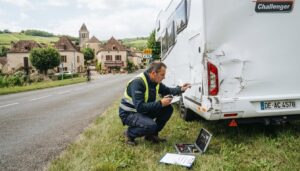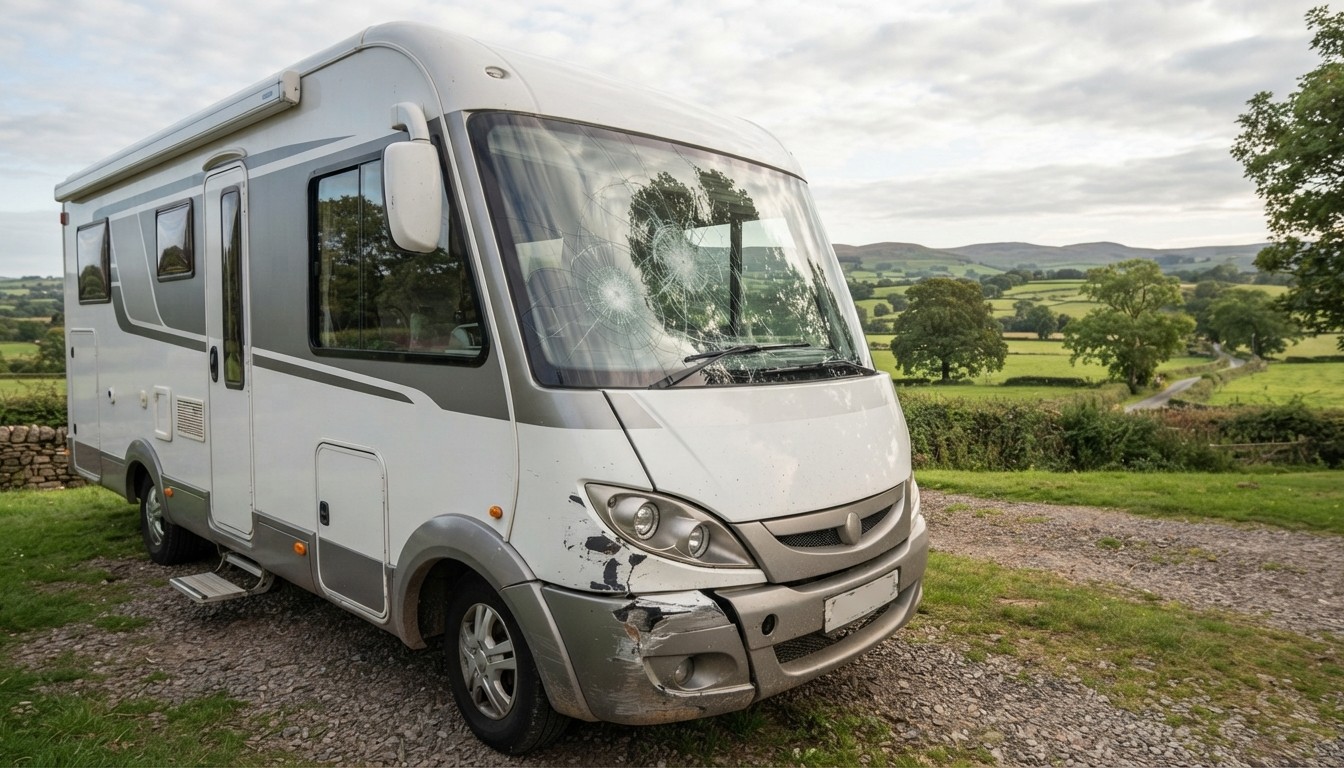
A-class panoramic glass and front-mask repairs can range from a chip repair to specialist glass or bodywork replacement, with parts availability, lead time and cost shaped by your motorhome’s model year, glass design, damage and installation fit. For a-class motorhome windshield and front mask damage, the panoramic shape, model-specific parts and front-mask work can make repairs more involved than ordinary car-glass work.
A stress crack develops from pressure or movement in the glass or its opening, rather than from a direct impact. The repair could involve glass, paint, the moulded front mask or the surrounding trim, and sometimes more than one of these parts.
Before you ask for quotes, identify your rig’s make, model and year. A class motorhome built in different years may use a different glass design, so owners should not rely on a broad model name alone.
Key Takeaways
- Record the make, model and year before requesting a repair quote.
- Glass, front-mask, paint and trim damage may need separate work.
- Specialist glass shape and fit can affect parts supply and timing.
- Ask a repairer familiar with A-class motorhomes to assess the damage.
- Keep the make, model and year to hand before you contact a repairer.
A-Class Motorhome Windshield and Front Mask Damage: What Should You Check First?
A small mark is not automatically minor if it is spreading, near the edge or affecting your view. Location and change matter: a chip in your direct sight line or a crack reaching the edge needs prompt professional assessment.
Record the damage before arranging work, including any changes to visibility, fit or sealing. Dirt and moisture can enter a fresh chip, while temperature changes and road vibration may make it worse.
Do not assume a small chip will stay small. A repaired chip can later spread, so keep a clear record of its condition.
One reported chip repair cost $65 and was completed the next morning. Seven months and nearly 10,000 miles later, the chip had spread into a crack, despite six further chips also appearing.
Use this checklist to note what you can see or hear:
- Chip position, size and any effect on your view.
- Crack spread, edge damage or more than one impact point.
- Wind noise, gaps, moisture or a change in the glass fit.
- Loose trim or visible impact damage to the front mask.
Take clear photographs from inside and outside, with enough light to show the mark and its position. Add the motorhome’s make, model and year to your notes, and check your policy for glass cover and any claim steps.
Photograph the damage before cleaning or covering it, so the initial condition is recorded.
Front Mask, Paint and Trim: Where Damage Spreads
A scuff in the paint and a crack through the front mask are different repair problems, even when they sit beside the same windscreen. The surface mark alone does not show whether the body beneath it is sound.
Damage near a seam needs a body inspection, even when the crack looks cosmetic. A split beside a joint can let water enter the coach, so the adjoining paint and trim need attention too.
Assessing the moulded front mask and paint
A front mask may be made from GRP, also called fibreglass, or from plastic. Scuffs, paint chips and shallow surface marks differ from deep fractures or impact damage close to seams.
The repairer should check the substrate, meaning the material beneath the paint, before refinishing. A surface repair may suit a shallow mark, while a fracture can call for more work on the moulded body part.
Look across the front mask in good light and note where the damage sits against the glass, seams and adjoining body. A chipped paint edge can expose the surface beneath it, while a deep split may change how adjoining parts meet.
Checking trim, seals and water entry
Loose capping, displaced trim and uneven gaps can point to a poor fit or damage around the glass. Wind noise and moisture inside the coach also deserve attention, particularly near the dashboard or front body joints.
Old adhesive may need to come off before a repairer can reseal the area. The mounting surface and clips should be checked first, since loose clips or residue can stop the trim sitting in place.
A mark that seems limited to paint can hide a gap at the seam, especially after an impact. Ask for the mask, adjoining paint and trim to be inspected together when damage reaches a seam.
Repair or Replace: Which Glass Damage Can Be Fixed?
A clean, limited chip away from your direct field of view is the clearest candidate for resin repair, but cracks and edge damage need a professional assessment. The laminate matters: a laminated windscreen has two glass layers joined by an interlayer.
Spreading, edge, structural or critical-view damage generally needs assessment for replacement. A small chip may be repairable if it has not gone through the laminate and does not affect your view.
A specialist can judge the chip’s depth, position and spread before choosing a repair. Resin fills the damaged area, but it cannot restore every windscreen to a safe condition.
One US guide uses a 6-inch crack as a replacement trigger. That is a rule of thumb, not German law, and a shorter crack is not automatically repairable.
Reported US prices for professional resin chip repair range from $55-$150. These are US figures, not a quote for a German repair, where the work and vehicle affect the price.
Ask the repairer to explain whether the damage can be repaired or needs replacement, and to record the reason in writing. A clear decision helps you understand what the work will address.
Why Parts Scarcity Extends the Repair Timeline
A special-order windscreen can take weeks to arrive, even before the fitting appointment is booked. The exact glass matters: model, year, shape, tint and part identification can affect what suppliers can find.
Special-order glass commonly takes 2-6 weeks, while OEM or discontinued glass can take 8-10 weeks. These are reported estimates, not a promise of delivery in Germany.
Identifying the glass before ordering
Confirm the exact make, model and year before a supplier orders a replacement. You also need to know whether the glass is one-piece or two-piece, its tint and any part identification available.
Small design differences can matter on an A-class motorhome, even when two vehicles share a model name. A correct match helps avoid ordering the wrong pane and losing time.
Have these details ready when you contact a glass specialist:
- Motorhome make and model.
- Year of manufacture or model year.
- One-piece or two-piece glass configuration.
- Glass tint and any visible part identification.
Allowing for freight and replacement orders
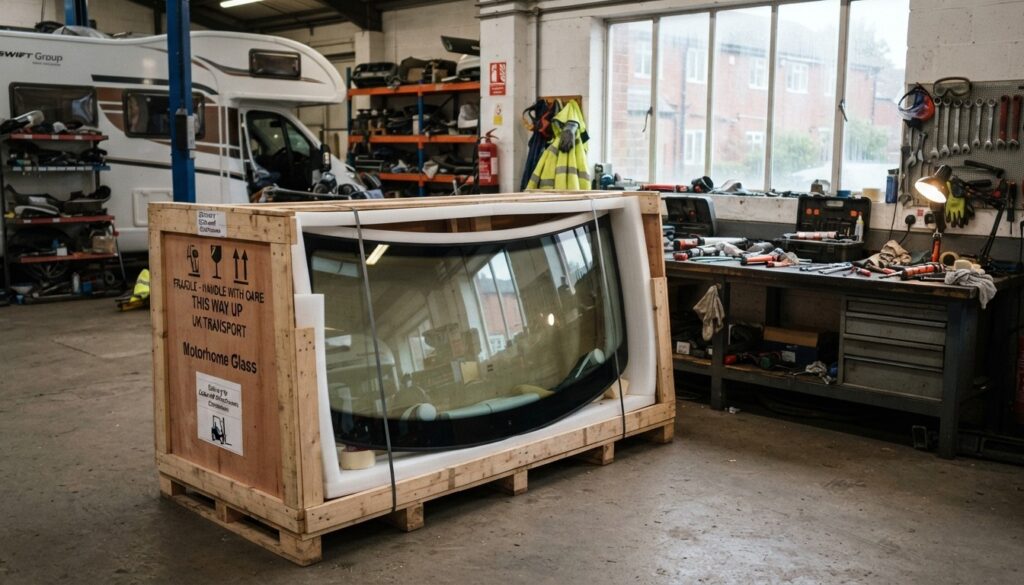
Large curved glass needs careful packing and transport. Reported US freight for a large curved screen adds $150-$400, but that is US context, not a German charge.
| Parts situation | Reported lead time | What can delay it |
|---|---|---|
| Typical special order | 2-6 weeks | Part identification and supplier stock |
| OEM or discontinued glass | 8-10 weeks | Limited remaining stock |
| Crated curved glass damaged in transit | Order may need to restart | Replacement shipment and new delivery slot |
Breakage in transit can mean waiting for another order rather than simply booking a new fitting date. Ask whether the quoted lead time starts at order placement or after the correct part is confirmed.
What Does A-Class Windshield Replacement Cost?
The available price examples are in US dollars, so use them to understand cost drivers rather than as a German quote. Glass shape makes a clear difference in the reported figures, especially for curved one-piece screens.
Reported US installed prices range from $1,200-$1,800 for one pane of two-piece flat glass to $3,000-$5,000+ for curved one-piece glass. Those figures do not set a German windshield replacement cost.
Reported price ranges by glass configuration
| Work or configuration | Reported US cost | Condition |
|---|---|---|
| Chip repair | $55-$150 | Professional resin repair |
| One pane, two-piece flat glass | $1,200-$1,800 | Installed price |
| Curved one-piece replacement | $3,000-$5,000+ | Installed price |
The glass configuration, OEM availability and freight all affect a quote. Labour, tax, gasket or adhesive materials, tint and any front-mask bodywork can also change the total.
These are reported US costs, not German prices for your rig. A local quote needs to match the exact glass and work required for your motorhome.
What a written quote should separate
A Newmar owner paid $1,450 for glass and $2,533 in total, with $826 out of pocket. The figures show why a glass price, labour charge and insurance payment should not be treated as one amount.
A separate quote for an older coach exceeded $8,000 for two panes. That example is not a typical price, but it shows how a specific coach and glass can change the bill.
Ask the repairer to set out the glass, freight, fitting, materials, tax and any body or paint work as separate lines. Request an itemised quote that separates glass, freight, fitting, materials, tax and any body or paint work.
Fit, Seals and Structural Checks Before Installation
A new pane will not solve a windscreen opening that is distorted or moving under chassis stress. Fit comes first, since the glass can crack again or fail to seal if the opening is out of shape.
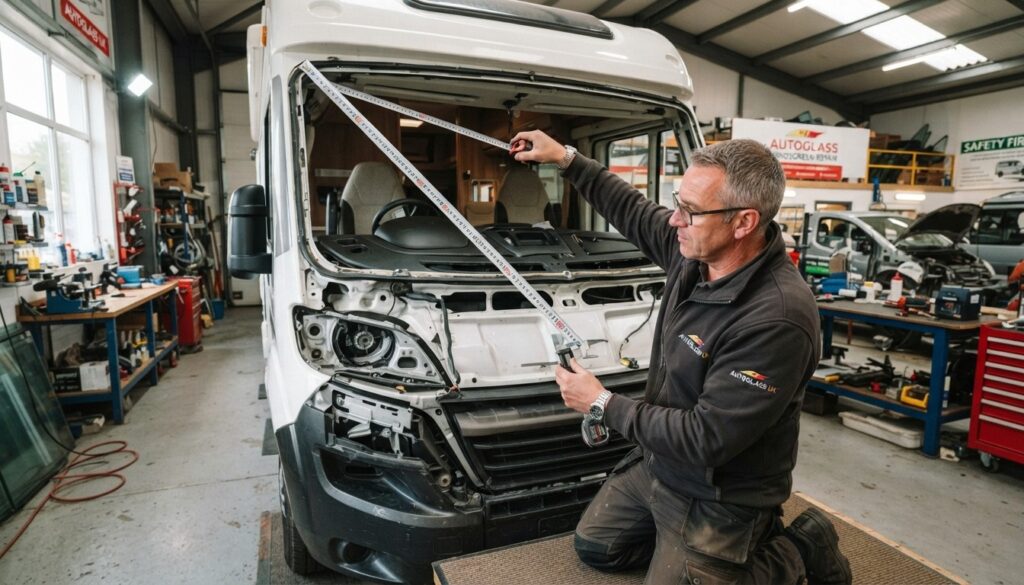
Installation guidance treats a diagonal difference above 1/2 inch as a warning of an out-of-square opening. Measure the opening with the coach level at ride height.
Checking whether the opening is square
Stress cracks, popped corners, a wind whistle or bulging glass can point to movement or poor support. A leaning coach can also signal a suspension or body issue that needs checking before a replacement.
Measure both diagonals across the opening. Guidance gives an ideal difference of no more than 3/8 inch and flags more than 1/2 inch as a warning.
These figures are installation guidance, not a universal legal specification. The coach should sit level at ride height during measurement, so the result reflects its normal position.
If you suspect a structural issue, ask for the measurements and photographs in writing. This gives you a record of the opening before the new pane goes in.
Confirming the fitting method and cure time
Gasket-set glass sits in a rubber channel, while adhesive-set glass bonds to the opening with urethane. The right fitting method depends on the vehicle’s design.
Incorrect preparation or seating can lead to leaks or repeat stress damage. For adhesive-set glass, the sealant needs at least 24 hours to cure before the coach moves, and longer in low humidity.
Ask the installer to confirm the fitting method and cure time for your specific work. Do not move an adhesive-set coach until the installer confirms the sealant has cured.
Insurance and Booking: What to Confirm Before Work Starts
Check your policy and obtain written approval before authorising a costly replacement. Glass and bodywork may have different cover, and your deductible can change what you pay.
Confirm the insurer’s approval, labour allowance and repair terms before work begins. A written quote gives you a clear basis for checking the claim and the planned work.
Do not assume that glass cover also pays for front-mask paint or extra labour. Get the insurer’s decision in writing before you authorise the repair.
Use this checklist before booking the work:
- Ask whether your policy covers glass or front-mask damage, and what deductible applies.
- Confirm whether the insurer needs to approve the work in advance.
- Check whether the labour allowance matches your chosen installer’s quote.
- Ask what installation work the repairer warrants, and for how long.
- Confirm any emergency accommodation cover directly with your insurer.
One documented claim included a $500 deductible and $326 in additional labour. One policy covered up to $750 per emergency incident for accommodation, while Newmar covered factory technician installation work for one year.
Those are individual policy or warranty examples, not terms you can assume apply to your claim. Keep the insurer’s approval, itemised quote and repairer’s written workmanship terms together.
Conclusion
The most useful first move is to identify the exact coach and document the damage clearly. Send the make, model, year and clear photographs when you request an assessment.
Two points matter most: confirm the exact part and damage before ordering, and choose a specialist who knows coach glass and front-mask work. That experience can help spot fit, trim or sealing concerns alongside the visible damage.
A written assessment should state what needs repair and which parts need replacement. Request a written assessment that covers the glass, front mask, trim and any fit or sealing concern.
FAQ
Can you drive an A-class motorhome with a cracked windscreen?
How long does an A-class motorhome windscreen take to arrive?
Can a small motorhome windscreen chip be repaired instead of replaced?
Does motorhome insurance cover front-mask paint damage as well as glass?
Why does a replacement windscreen crack again after fitting?
Is a one-piece panoramic windscreen always more expensive than a two-piece windscreen?
Wycena szkody: samodzielnie czy z rzeczoznawcą MOTOEXPERT?
Porównaj, zanim ubezpieczyciel zdecyduje za Ciebie.
| ✗ Samodzielnie (kalkulator / AI ubezpieczyciela) | ✓ Z MOTOEXPERT + rekomendowany Adwokat |
|---|---|
| Wycena rzeczoznawcy ubezpieczyciela — interes płatnika, ryzyko zaniżenia | Niezależna certyfikowana opinia techniczna — pełny kosztorys wg stawek rynkowych |
| Pominięte pozycje: utrata wartości, auto zastępcze, holowanie | Komplet roszczeń: utrata wartości pojazdu, auto zastępcze, koszty dodatkowe |
| Samotne negocjacje z ubezpieczycielem, bariera językowa | Obsługa po polsku + rekomendowany Fachanwalt für Verkehrsrecht do reprezentacji prawnej |
| Sztuczna inteligencja nie stanie za Tobą w sądzie — koszt błędu ponosisz Ty | Szkoda z OC sprawcy w Niemczech przy jednoznacznej odpowiedzialności: uzasadnione koszty rzeczoznawcy co do zasady pokrywa ubezpieczyciel sprawcy (§ 249 BGB) |
📷 Zgłoś szkodę przez WhatsApp — wstępna ocena na podstawie zdjęć